【案例】基于透视变换的答题卡正确率识别
在基于透视变换的答题卡正确率识别中,如图右半部分,首先,对图片进行图像预处理,包括转化为灰度图,高斯滤波去噪;然后,通过边缘检测对答题卡的外部轮廓进行检测,来进行透视变换,具体方法为通过cv2.findContours函数检测最大轮廓,计算出外轮廓四个点,并通过它们的横纵坐标值进行排序,通过这四个点进行透视变换来得到只有答题卡的图像;再对图像进行阈值处理,通过cv2.findContours检测每一个选项的外部圆圈轮廓,该步骤中的轮廓需满足自己设定的尺寸要求,并对所有轮廓先进行一行排序,再对一行中的轮廓进行顺序排序;最后,在每一个轮廓处生成全填充mask来与阈值化后的图像进行与运算,计算得分,最高分则为答题卡这一行中所选择的选项,与初始定义的正确答案字典对比即可判断该题是否正确,遍历每一行,则可以得到该份答题卡的正确率,如图左半部分,左上角为正确率,每一行中黑色圆圈部分为该题的正确选项。
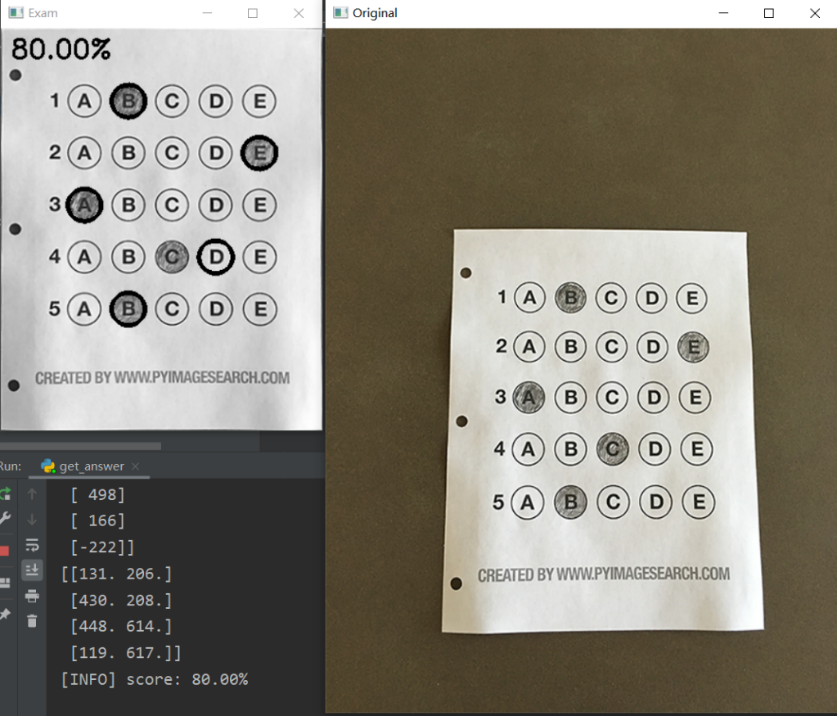
代码如下:
# 导入工具包
import numpy as np
import cv2
import argparse

# 设置参数
ap = argparse.ArgumentParser()
ap.add_argument("-i", "--image", required=True,
                help="path to the input image")
args = vars(ap.parse_args())

# 正确答案
ANSWER_KEY = {0: 1, 1: 4, 2: 0, 3: 3, 4: 1}


# 将四个坐标点进行排序归类
def order_points(pts):
    # 一共4个坐标点
    print(pts)
    rect = np.zeros((4, 2), dtype="float32")

    # 按顺序找到对应坐标0 1 2 3分别是 左上,右上,右下,左下
    # 计算左上,右下
    s = pts.sum(axis=1)
    print(s)
    rect[0] = pts[np.argmin(s)]  # 默认将列表展平,最小值下标
    rect[2] = pts[np.argmax(s)]
    # 计算右上和左下
    diff = np.diff(pts, axis=1)
    print(diff)
    rect[1] = pts[np.argmin(diff)]
    rect[3] = pts[np.argmax(diff)]
    print(rect)

    return rect


def four_point_transform(image, pts):
    # 获取输入坐标点
    rect = order_points(pts)
    (tl, tr, br, bl) = rect
    # 计算输入的w和h值
    WidthA = np.sqrt(((br[0] - bl[0]) ** 2) + ((br[1] - bl[1]) ** 2))
    WidthB = np.sqrt(((tr[0] - tl[0]) ** 2) + ((tr[1] - tl[1]) ** 2))
    maxWidth = max(int(WidthA), int(WidthB))

    HeightA = np.sqrt(((tr[0] - br[0]) ** 2) + ((tr[1] - br[1]) ** 2))
    HeightB = np.sqrt(((tl[0] - bl[0]) ** 2) + ((tl[1] - bl[1]) ** 2))
    maxHeight = max(int(HeightA), int(HeightB))

    # 变换后对应坐标位置
    dst = np.array([
        [0, 0],
        [maxWidth - 1, 0],
        [maxWidth - 1, maxHeight - 1],
        [0, maxHeight - 1]], dtype="float32")

    # 计算变换矩阵
    M = cv2.getPerspectiveTransform(rect, dst)
    warped = cv2.warpPerspective(image, M, (maxWidth, maxHeight))
    # 返回变换后结果
    return warped


def  sort_contours(cnts, method="left-to-right"):
    reverse = False
    i = 0
    if method == "right-to-left" or method == "bottom-to-top":
        reverse = True
    if method == "top-to-bottom" or method == "bottom-to-top":
        i = 1
    boundingBoxes = [cv2.boundingRect(c) for c in cnts]  # x,y,w,h
    (cnts, boundingBoxes) = zip(*sorted(zip(cnts, boundingBoxes),
                                        key=lambda b: b[1][i], reverse=reverse))
    return cnts, boundingBoxes


def cv_show(name, img):
    cv2.imshow(name, img)
    cv2.waitKey(0)
    cv2.destroyAllWindows()


# 预处理
image = cv2.imread(args['image'])
contours_img = image.copy()
gray = cv2.cvtColor(image, cv2.COLOR_BGR2GRAY)
blurred = cv2.GaussianBlur(gray, (5, 5), 0, 0)
cv_show('blurred', blurred)
edged = cv2.Canny(blurred, 75, 200)  # 边缘检测
cv_show('edged', edged)

# 轮廓检测
cnts = cv2.findContours(edged.copy(), cv2.RETR_EXTERNAL,
                        cv2.CHAIN_APPROX_SIMPLE)[0]
# cv2.findContours()函数接受的参数为二值图,即黑白的(不是灰度图),所以读取的图像要先转成灰度的,再转成二值图
# 注意该函数与cv库版本相关,返回参数个数不同,return一个列表
cv2.drawContours(contours_img, cnts, -1, (0, 0, 255), 3)
cv_show('contours_img', contours_img)
docCnt = None

# 确保检测到了
if len(cnts) > 0:
    # 根据轮廓大小进行排序,降序
    print(cnts)
    cnts = sorted(cnts, key=cv2.contourArea, reverse=True)
    # cnts = sorted(cnts, key=None, reverse=True)

    # 遍历每一个轮廓
    for c in cnts:
        # 近似轮廓   c  二位点集数组   approx 多边形轮廓近似
        peri = cv2.arcLength(c, True)
        approx = cv2.approxPolyDP(c, 0.02 * peri, True)

        # 准备做透视变换
        if len(approx) == 4:
            docCnt = approx
            break

# 执行透视变换
warped = four_point_transform(gray, docCnt.reshape(4, 2))
cv_show('warped', warped)

# Otsu's 自适应阈值处理
thresh = cv2.threshold(warped, 0, 255,
                       cv2.THRESH_BINARY_INV | cv2.THRESH_OTSU)[1]
cv_show('thresh', thresh)
thresh_Contours = thresh.copy()

# 找到每一个圆圈轮廓,不能用霍夫变换
cnts = cv2.findContours(thresh, cv2.RETR_EXTERNAL,
                        cv2.CHAIN_APPROX_SIMPLE)[0]
cv2.drawContours(thresh_Contours, cnts, -1, (0, 0, 255), 3)
cv_show('thresh_Contours', thresh_Contours)

questionCnts = []

# 遍历
for c in cnts:
    # 计算比例和大小
    (x, y, w, h) = cv2.boundingRect(c)
    ar = w / float(h)

    # 根据实际情况指定标准
    if w >= 20 and h >= 20 and ar >= 0.9 and ar <= 1.1:
        questionCnts.append(c)

# 按照从上到下进行排序
questionCnts = sort_contours(questionCnts,
                             method="top-to-bottom")[0]
correct = 0

# 每排有5个选项
for (q, i) in enumerate(np.arange(0, len(questionCnts), 5)):
    # 排序
    cnts = sort_contours(questionCnts[i:i + 5])[0]
    bubbled = None

    # 遍历每一个结果
    for (j, c) in enumerate(cnts):
        # 使用mask来判断结果
        mask = np.zeros(thresh.shape, dtype="uint8")
        cv2.drawContours(mask, [c], -1, 255, -1)  # -1表示填充
        cv_show('mask', mask)
        # 通过计算非零点数量来算是否选择这个答案
        mask = cv2.bitwise_and(thresh, thresh, mask=mask)
        total = cv2.countNonZero(mask)

        # 通过阈值判断
        if bubbled is None or total > bubbled[0]:
            bubbled = (total, j)
    # 对比正确答案
    color = (0, 0, 255)
    k = ANSWER_KEY[q]

    # 判断正确
    if k == bubbled[1]:
        color = (0, 255, 0)
        correct += 1

    # 绘图
    cv2.drawContours(warped, [cnts[k]], -1, color, 3)

score = (correct / 5.0) * 100
print("[INFO] score: {:.2f}%".format(score))
cv2.putText(warped, "{:.2f}%".format(score), (10, 30),
            cv2.FONT_HERSHEY_SIMPLEX, 0.9, (0, 0, 255), 2)
cv2.imshow("Original", image)
cv2.imshow("Exam", warped)
cv2.waitKey(0)
cv2.destroyAllWindows()